

Amazon has opened its logistics network to the wider market, turning freight, fulfilment, distribution and parcel delivery into a new business line. For the global supply chain industry, this may be less of a product launch and more of a warning shot.
Amazon did not simply launch a new logistics service this week. It revealed what may be one of the clearest examples yet of its business philosophy: build infrastructure for yourself, scale it until it becomes world class, then sell it to everyone else.
That was the AWS playbook. Now Amazon appears to be applying the same logic to supply chain.
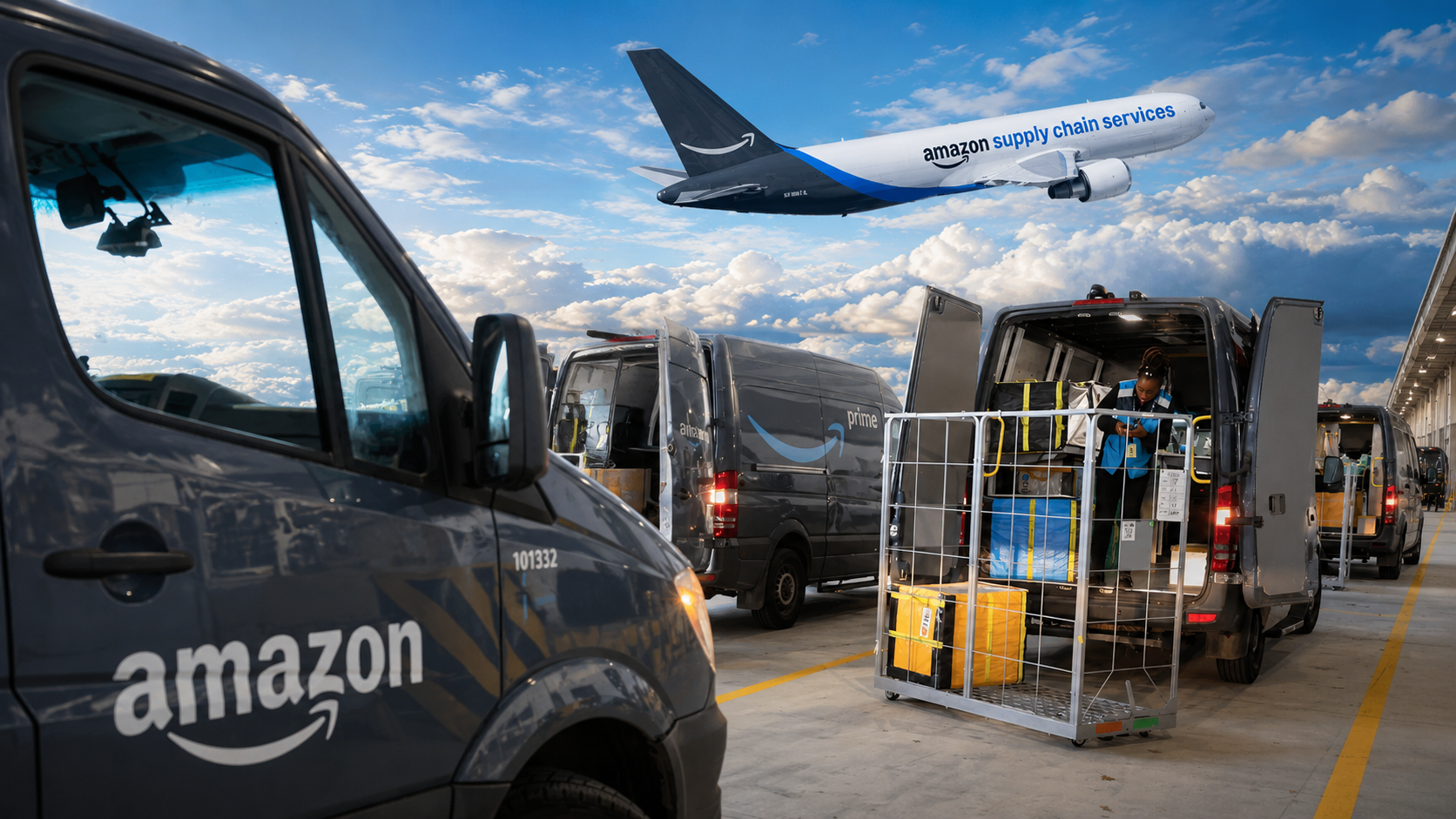
On May 4, 2026, Amazon announced the launch of Amazon Supply Chain Services, opening its freight, distribution, fulfilment and parcel shipping capabilities to businesses of all sizes including companies that do not sell on Amazon’s marketplace. The service allows companies to move, store and deliver goods ranging from raw materials to finished products through the same network Amazon built to support its own retail machine.
In other words, the warehouse was never just a warehouse. The delivery van was never just a delivery van. The fulfilment centre was never just a cost centre. It was infrastructure waiting to become a product.
Amazon’s first named customers make the ambition clear. Procter & Gamble is using Amazon’s freight services to move raw materials into production facilities and finished goods across its distribution network. 3M is using Amazon freight to move products from manufacturing sites to distribution centres. Lands’ End is using Amazon’s network to unify inventory and fulfil orders across multiple sales channels, while American Eagle Outfitters is using Amazon’s parcel shipping network for nationwide direct-to-consumer deliveries.
This is not a side experiment. It is Amazon stepping directly into the territory of UPS, FedEx, DHL, GXO, XPO, freight forwarders, third-party logistics providers and parts of the contract logistics sector. Reuters reported that shares of UPS and FedEx fell more than 9% following the announcement, while DHL was down 7.3% and GXO fell nearly 13%, reflecting how quickly the market understood the competitive implications.
The reason investors reacted so sharply is simple: Amazon has not entered logistics as a start-up. It has entered as one of the most scaled operators in the world.
The company says its freight network spans ocean, air, ground and rail, supported by more than 80,000 trailers, 24,000 intermodal containers and 100 aircraft. Its parcel offer includes predictable two-to-five-day delivery speeds, seven-day service, shipment tracking, flexible pickup and photo-on-delivery capabilities.
For years, this machine was understood primarily as the engine behind Prime. Now Amazon wants the market to understand it differently: as a supply chain platform.
That distinction matters. Logistics has traditionally been treated as a service business trucks, warehouses, aircraft, drivers, packages, contracts and lanes. Amazon is reframing it as infrastructure: a connected operating system for moving goods across channels, geographies and demand patterns.
Peter Larsen, vice president of Amazon Supply Chain Services, made the AWS comparison explicit, saying Amazon is bringing the “infrastructure, intelligence, and scale” of its supply chain to businesses in a way similar to how AWS brought cloud computing to the wider market.
That is the line competitors will be reading carefully.
AWS began as a solution to Amazon’s own internal computing needs before becoming one of the most important cloud infrastructure businesses in the world. With Amazon Supply Chain Services, the company is again taking an internal capability and externalising it. The difference is that this time the infrastructure is not server capacity. It is physical movement: containers, aircraft, trailers, fulfilment centres, forecasting models, inventory placement, last-mile networks and operational density.
For manufacturers, retailers, consumer brands and healthcare companies, the proposition is attractive. Instead of stitching together multiple logistics providers for freight, storage, fulfilment and parcel delivery, they can plug into a single network with global scale and Amazon’s data-led operating model. Amazon says businesses can use the service across their own websites, ecommerce marketplaces, social media channels and physical stores.
For traditional logistics companies, the challenge is more uncomfortable. Amazon has spent decades becoming exceptional at one of the hardest problems in commerce: getting the right product close enough to the right customer before the customer even knows they want it. That experience now becomes a commercial weapon.
The timing is also significant. UPS and FedEx have both been working to move towards higher-margin business-to-business and specialised logistics segments, including healthcare and more predictable commercial shipments. Amazon’s move lands directly in that strategic space. Reuters noted that business-to-business shipping is a prized, higher-margin segment because deliveries are often denser, more predictable and less expensive to serve than consumer shipments.
This does not mean Amazon will immediately replace the incumbents. Logistics is not cloud computing. It is asset-heavy, labour-intensive, regulated, weather-exposed and operationally unforgiving. Planes do not scale like servers. Warehouses do not replicate like software. A delayed truck cannot be solved with a line of code.
But that may also be why Amazon’s entry matters.
The company has already absorbed the pain of building the network. It has already spent the capital. It has already trained the algorithms, negotiated the routes, filled the fulfilment centres, built the air network, learned the failure points and refined the customer promise. The new business is not starting with theory. It is starting with installed infrastructure.
For the global infrastructure and logistics sector, this is the most important lesson. The next generation of infrastructure companies may not only be those that build roads, ports, airports, railways and warehouses. They may be the companies that turn those physical systems into platforms.
Amazon Supply Chain Services is therefore not just about parcels. It is about the monetisation of operational knowledge. It is about turning complexity into a sellable product. It is about the idea that the hidden systems behind modern commerce forecasting, fulfilment, inventory positioning, route optimisation and delivery reliability are now strategic infrastructure.
Amazon built its retail empire by solving its own supply chain problem. Now it wants other businesses to pay to use the solution.
That is why this launch matters. Not because Amazon has discovered logistics, but because Amazon has decided logistics is no longer merely the cost of doing business.
It is the business.