

Ultra-high performance concrete has been in labs and specialty projects for three decades. What’s different now is where it’s turning up: on aging viaducts in Switzerland, a busy interstate crossing between Delaware and New Jersey, county bridges in Iowa and New Mexico, and a 100% UHPC superstructure in Michigan. Together, those projects show why many bridge owners now see UHPC as a practical tool for extending deck life—not just a science project.
What UHPC Actually Buys You
Ultra-high performance concrete (UHPC) is a fine-grained, fiber-reinforced cementitious mix with compressive strengths typically above 150 MPa (21.7 ksi)—three to seven times that of conventional bridge concrete. It uses very fine sand, silica fume, a low water-binder ratio, high-range water reducers and steel fibers to produce a dense, low-permeability matrix.
For owners, the key isn’t only strength. It’s durability and the ability to do more with less section:
- Very low permeability means better protection against chlorides and freeze-thaw.
- High tensile capacity and fiber bridging allow very thin overlays and elements to carry traffic and resist cracking.
- Prefabrication or thin overlays fit well with accelerated bridge construction (ABC) and tight lane-closure windows.
FHWA now counts more than 350 UHPC bridge applications in the U.S. between 2006 and 2021, most of them in connections, joints and overlays. The common thread: owners using UHPC to stretch the life of existing assets without full deck replacement.
Chillon Viaducts: Early Proof on a Strategic Corridor
One of the best early demonstrations of UHPC overlays is the twin Chillon Viaducts above Lake Geneva in Switzerland, a critical link on the A9 motorway. The 1960s-era prestressed concrete box-girder structures needed waterproofing and strengthening without adding much dead load or disrupting traffic for long periods.
Contractor WALO and Holcim’s Ductal UHPC were used to place an ultra-thin overlay—on the order of 45–60 mm—across roughly 52,000 m² of deck. The UHPC layer provided both a waterproofing barrier and additional flexural capacity while keeping added weight to a minimum.
Key outcomes that matter to other owners:
- The viaducts gained a new, continuous protective skin without milling down to primary reinforcement.
- The thin layer minimized dead-load increase on already heavily stressed box girders.
- Work was sequenced with partial lane closures, keeping traffic moving on a corridor that cannot easily be shut down.
Chillon has become a reference case for other agencies evaluating UHPC overlays on viaducts and long-span structures.
Delaware Memorial Bridge: UHPC at Turnpike Scale
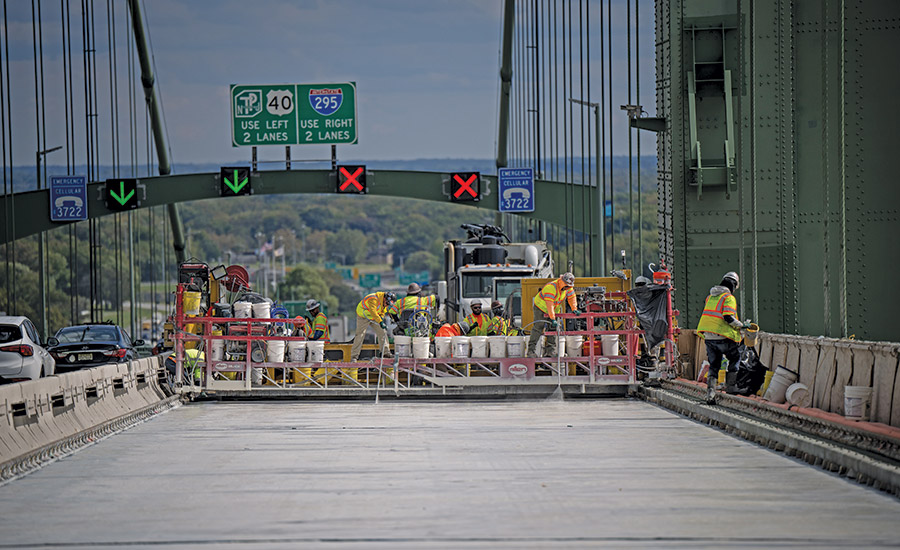
If Chillon was proof of concept, the Delaware Memorial Bridge is UHPC at toll-bridge scale. The twin 13,500-ft suspension structures carry more than 80,000 vehicles per day between Delaware and New Jersey. By late 2023, UHPC Solutions North America had completed a 14-month, three-phase rehabilitation that placed roughly 5,000 yd³ of Holcim’s Ductal UHPC as a deck overlay.
The specialty contractor, backed by parent firms Posillico and WALO, milled the existing deck down to sound concrete, then placed the UHPC overlay in carefully planned closures. Saint-Gobain Construction Chemicals’ Chryso and GCP brands supported the work with admixture design and on-site technical teams to keep the very low-slump, fiber-rich mix within specification throughout long shifts.
For the Delaware River & Bay Authority, the project offered:
- A durable new wear surface and waterproofing layer expected to significantly extend deck life.
- A solution thin enough to stay within weight and geometry constraints on an existing suspension system.
- A repeatable overlay “recipe” that can be referenced on future contracts.
That combination—high-volume deck work, a large traffic load, and a documented construction playbook—is an important signal that UHPC overlays are moving into mainstream rehabilitation practice, not just one-off experiments.
County Bridges: Open-Recipe Mixes and Cost Pressure
High-profile viaducts and toll bridges grab attention, but many of the most instructive UHPC deployments are small rural bridges where budgets are tight.
Mud Creek Bridge, Iowa. One of the first UHPC deck overlays in the U.S. was placed on a county bridge near Independence, Iowa. Researchers working with the Iowa DOT and local officials used the bridge as a test bed for a non-proprietary UHPC mix, proving that locally sourced materials and standard ready-mix equipment could deliver the required performance at lower material cost.
Socorro County, New Mexico. A more recent project near Socorro applied a thin, non-proprietary UHPC overlay to a bridge carrying New Mexico Highway 1. Backed by the Tran-SET university research consortium, the team focused on cost, constructability and long-term monitoring.
Both projects tell a similar story:
- UHPC overlays can be batched and placed with conventional equipment if the mix is designed for that purpose.
- Thin sections help make the economics work, even when material cost per cubic yard is several times that of standard concrete.
- Early-age cracking and interface prep remain critical; both bridges invested heavily in surface preparation and curing controls.
Bricker Road: A 100% UHPC Superstructure
In 2022, Michigan’s Bricker Road Bridge over the Quackenbush Drain became the first U.S. bridge with a 100% UHPC superstructure. The St. Clair County Road Commission replaced a deteriorated reinforced concrete deck with six precast ribbed UHPC panels spanning 22 ft and about one-third the weight of the original slab.
The open-recipe UHPC—mixed on site in conventional ready-mix trucks—was reinforced with HiPer Fiber’s Type X striated steel fibers, which are engineered to increase fiber-matrix bond strength and ductility while reducing fiber dosage.
For a small rural bridge, the implications are big:
- Weight reduction allowed the existing substructure to be reused, saving cost and construction time.
- All-UHPC deck panels demonstrated that non-proprietary mixes and advanced fibers can deliver design-level performance outside the lab.
- The project created a template for other counties that want long-life decks but cannot justify large proprietary UHPC budgets.
Sprayable UHPC: Next Step in Field Application
If overlays and panels are today’s UHPC use cases, sprayable UHPC may be tomorrow’s.
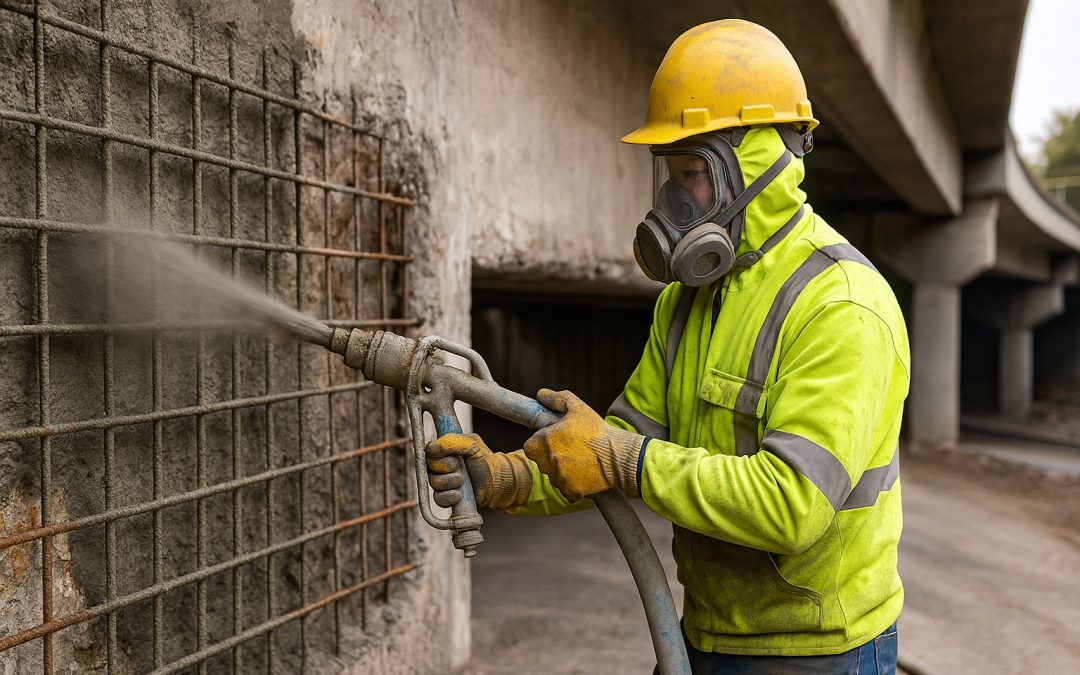
Researchers at Florida International University (FIU) have developed a non-proprietary sprayable UHPC and are building a mobile unit that can carry all required mixing, pumping and spraying equipment to bridge sites. The aim is to handle girder ends, abutment walls and culverts with thin sprayed coats, avoiding formwork and long closures.
Key points for owners and contractors:
- FIU’s modified UHPC mix targets a material cost in the hundreds—not thousands—of dollars per cubic yard by avoiding proprietary binders.
- Pneumatic application lets crews treat vertical and overhead surfaces quickly, with minimal added dead load.
- The U.S. DOT-sponsored research program is explicitly focused on training: the mobile unit doubles as a field classroom to get more contractors comfortable with the equipment and process.
Commercial firms such as UHPC Technologies are also pushing spray-applied systems into bridge and marine repair markets, combining proprietary mixes with dedicated spray rigs and method statements.
Supply Chain: From Proprietary Blends to Open Toolkits
Globally, the UHPC ecosystem now includes:
- Material and admixture suppliers such as Holcim (Ductal) and Saint-Gobain’s Chryso/GCP teams, who support large overlay projects like Delaware Memorial Bridge with mix design and field support.
- Specialty contractors such as UHPC Solutions North America and WALO, with proprietary placing equipment and teams that focus almost exclusively on UHPC overlays and repairs.
- Fiber innovators such as HiPer Fiber, whose striated steel fibers are tuned for UHPC and can cut fiber usage while maintaining ductility and strength.
- Open-recipe research groups at Iowa State, FIU, University of Michigan and others, developing non-proprietary mixes and publishing performance data for state DOTs.
For owners and engineers, that means more options—but also more due diligence. Specifications need to be clear on whether proprietary systems are required or whether performance-based criteria can open the field to non-proprietary mixes and local materials.
What It Will Take to Scale
Despite its advantages, UHPC is still a niche material in bridge engineering. Recent reviews point to familiar barriers: higher upfront material cost, a lack of widely adopted design codes, the need for specialized batching and curing, and limited contractor experience.
From recent deployments, several scale-up priorities are clear:
- Standardized design guidance. FHWA’s design and construction guides for UHPC-based elements and overlays are a step toward consistent detailing, load models and durability assumptions. Getting those provisions into state manuals will accelerate routine use.
- Simple, performance-based specs. Owners that specify required bond strength, permeability and thickness—rather than naming a brand—create room for both proprietary and open-recipe solutions.
- Contractor training and equipment. UHPC isn’t “just another mix.” Projects like Delaware Memorial Bridge and FIU’s sprayable program show that success depends on experienced crews, well-tuned equipment, and clear method statements.
- Lifecycle cost storytelling. On paper, a thin UHPC overlay that adds decades of service life and reduces future interventions can be cost-competitive. Portfolio-level data from Swiss motorway viaducts, U.S. toll bridges and county structures will help make that case to budget-constrained agencies.
For BE Global Infrastructure’s audience—owners, contractors and suppliers—the message is straightforward: UHPC is no longer an exotic material reserved for a handful of signature bridges. It is becoming a practical rehabilitation and replacement tool, especially where thin, durable overlays and lightweight decks can unlock more capacity from existing structures.
The next few years will show whether that tool stays in the “innovation” box—or becomes a standard line item in bridge programs worldwide.