

Peru sits at a crossroads. A country of extraordinary natural wealth — copper, gold, lithium, agricultural surplus — it has long struggled with the infrastructure gap that prevents it from fully capturing that wealth. Now, after years of political instability and procurement delays, the dam is breaking.
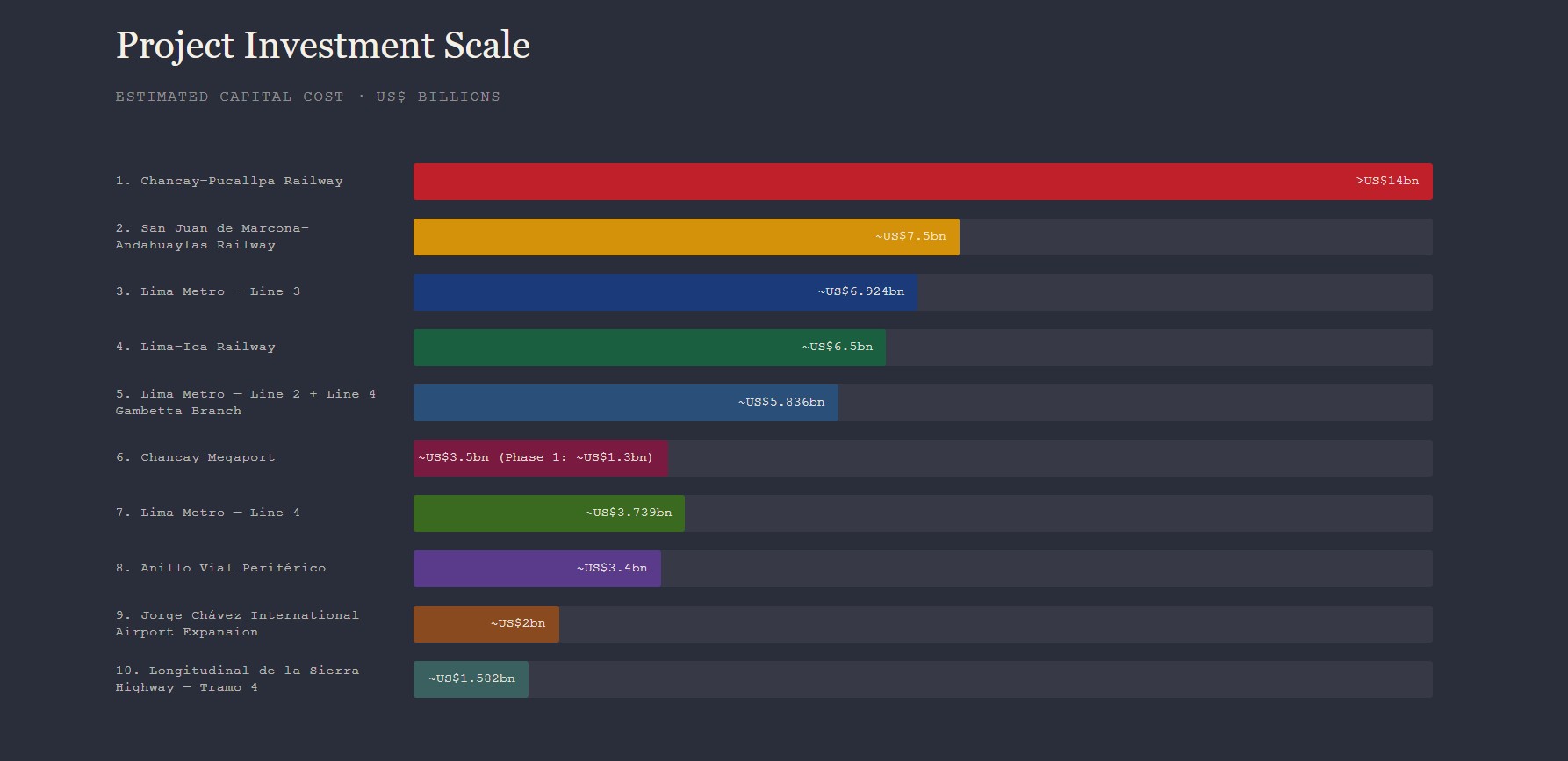
Ten mega-projects totalling more than $54 billion are moving through Peru's pipeline simultaneously — a mix of Chinese Belt and Road bets, Spanish PPP consortia, G2G agreements with European partners, and long-deferred domestic rail dreams. Together they represent the most ambitious infrastructure programme in Peruvian history. This is the definitive guide: what each project involves, who is building it, and what it means.
The Ten Projects
1. Chancay–Pucallpa Railway
The Trans-Andean Freight Corridor That Would Reshape South American Trade
>US$14bn
If H2 Magallanes is Chile's moonshot, the Chancay–Pucallpa Railway is Peru's. Proposed as a direct freight and passenger rail link between the new Chancay megaport on the Pacific and Pucallpa in the Amazon basin, the corridor would effectively create a new Trans-Andean land bridge connecting South America's Atlantic and Pacific coasts.
With a cost estimate exceeding $14 billion, the project dwarfs everything else in Peru's pipeline. The alignment would cross the Andes at extreme altitude, posing formidable engineering challenges. Peru and Brazil formally announced a joint feasibility exploration in July 2025, linking this project to Brazil's ambition to route Amazon basin agricultural exports through Chancay rather than Atlantic ports. No EPC contracts or concession structures have been announced; the project remains a long-horizon concept with political momentum but no committed financing.
Length~750 km crossing the Andes
Strategic Link Pacific coast ↔ Amazon basin
Stage Concept / bilateral study
Sponsor(s) Government of Peru / MTC — tied to Chancay port hinterland strategy
Location Chancay (Pacific coast) → Pucallpa (Amazon basin) ~750 km
Key Contractors & Suppliers
Strategic Backer (interest)
COSCO / Chinese State Entities - China
Likely EPC Model
Chinese state contractors (CRCC, CCCC, CRIG) — if BRI-funded - China
Feasibility Study Partners
Peru MTC + Brazil ANTT (transport agencies) - Peru / Brazil
No contractors or concessionaires formally appointed. If advanced under Belt and Road Initiative financing, Chinese state contractors would likely dominate EPC. A PPP or G2G route would open competition to international bidders.
Development Progress - 5%
2. San Juan de Marcona–Andahuaylas Railway
Unlocking Peru's Southern Mining and Agricultural Interior
~US$7.5bn
Peru's southern highland regions — Ica, Arequipa, Ayacucho, Apurímac — contain some of the most mineral-rich terrain in the world yet remain poorly connected to export infrastructure. The San Juan de Marcona–Andahuaylas Railway is conceived to resolve this, creating a direct rail corridor between the Pacific port of Marcona and the highland interior.
At approximately $7.5 billion, the project completed its feasibility phase and is moving into technical design and delivery model definition. The 560-kilometre alignment would serve mining operations across five departments, facilitate agricultural exports, and connect approximately 6 million people to improved transport. In March 2024, Jinzhao Peru — the Peruvian subsidiary of a Chinese iron mining company — won a tender to construct a new port at San Juan de Marcona that would anchor the rail terminus, adding strategic coherence to the corridor.
Length560 km, 5 departments
Population Served~6 million
Stage Technical design / delivery model
Sponsor(s) Government of Peru / MTC
Location San Juan de Marcona (Ica) → Andahuaylas (Apurímac) — 560 km
Key Contractors & Suppliers
Port (Terminus) Construction- Jinzhao Peru (subsidiary of Chinese iron mining co.)
Feasibility Engineering- MTC internal + external consultants- Peru / International
EPC / Concession (TBD)
Tender not yet launched — G2G or PPP model under evaluation - TBD
Delivery model (G2G, PPP, or public works) has not been formally determined. Given Peru's increasing use of G2G contracting for major rail projects, a European or North American government partner is possible.
Development Progress - 8%
3. Lima Metro — Line 3
The Capital's Future North–South Underground Spine
~US$6.924bn
Line 3 is the most anticipated metro project in Lima's history: a full north–south underground corridor that would carry the city's single highest-demand transit flow. Running from northern Lima through the city centre to the south, it will intersect every other metro line — making it the backbone of the entire future network.
With a cost estimate of nearly $7 billion, Line 3 is the most expensive single urban transit investment ever proposed in Peru. The government has been pursuing a Government-to-Government (G2G) delivery model, with partner countries expected to be announced. Peru's Minister of Economy and Finance set an award target of 2026 under a PPP structure. Concerns have been raised in Peru that a pure G2G or public works model would not be financially viable given the investment scale — a PPP with strong state co-financing is the likely path.
Alignment- North–south through central Lima
Delivery Model - PPP / G2G under structuring
Award Target- 2026 (per Minister of Finance)
Sponsor(s)- Government of Peru / MTC — via Pro Inversión PPP
Location- Lima Metropolitan Region — north–south axis
Key Contractors & Suppliers
G2G Partner Country (TBA) - Partner country announcement expected 2025–2026- TBD
Likely Rolling Stock Contenders - Alstom, CAF, Siemens Mobility, CRRC- France / Spain / Germany / China
Engineering Advisor - TYPSA (has Line 2 precedent in Lima)- Spain
Likely Rolling Stock Contenders - Alstom, CAF, Siemens Mobility, CRRC- France / Spain / Germany / China
Likely Civil Contenders - Webuild (Salini), FCC, Dragados, CRCC- Italy / Spain / China
No contracts awarded. The project is in structuring. Peru is actively seeking a government partner for a G2G arrangement — Korea, France, and Spain have all been mentioned in regional press as interested parties.
Development Progress- 10%
4. Lima–Ica Railway
A New Coastal Rail Artery for Passengers and Freight
~US$6.5bn
The Lima–Ica corridor is one of Peru's busiest inter-city routes: a 300-kilometre stretch of Pacific coastline connecting the capital to the agricultural heartland of Ica and serving a population of millions. Today it is served entirely by road. A dedicated rail link for passengers and freight would transform the corridor.
The project is being developed with technical assistance from the British government and the Inter-American Development Bank as part of a revised Peruvian national rail plan developed in 2024–2025. At $6.5 billion, it represents a major state commitment. The rail plan aims to integrate the Lima–Ica corridor with port access and other modes. However, like the other long-range rail corridors on this list, the project has not yet reached the stage of committed delivery structures or EPC contracting.
Length~300 km Lima–Ica coastal corridor
Service Type Passenger + freight
Technical Partner UK Government + IDB
Sponsor(s)- Government of Peru / MTC / British G2G programme
Location Lima → Ica (~300 km south via Pacific coastal corridor)
Development Progress- 6%
5. Lima Metro — Line 2 + Line 4 Gambetta Branch
Lima's Flagship East–West Metro — Under Construction
~US$5.836bn
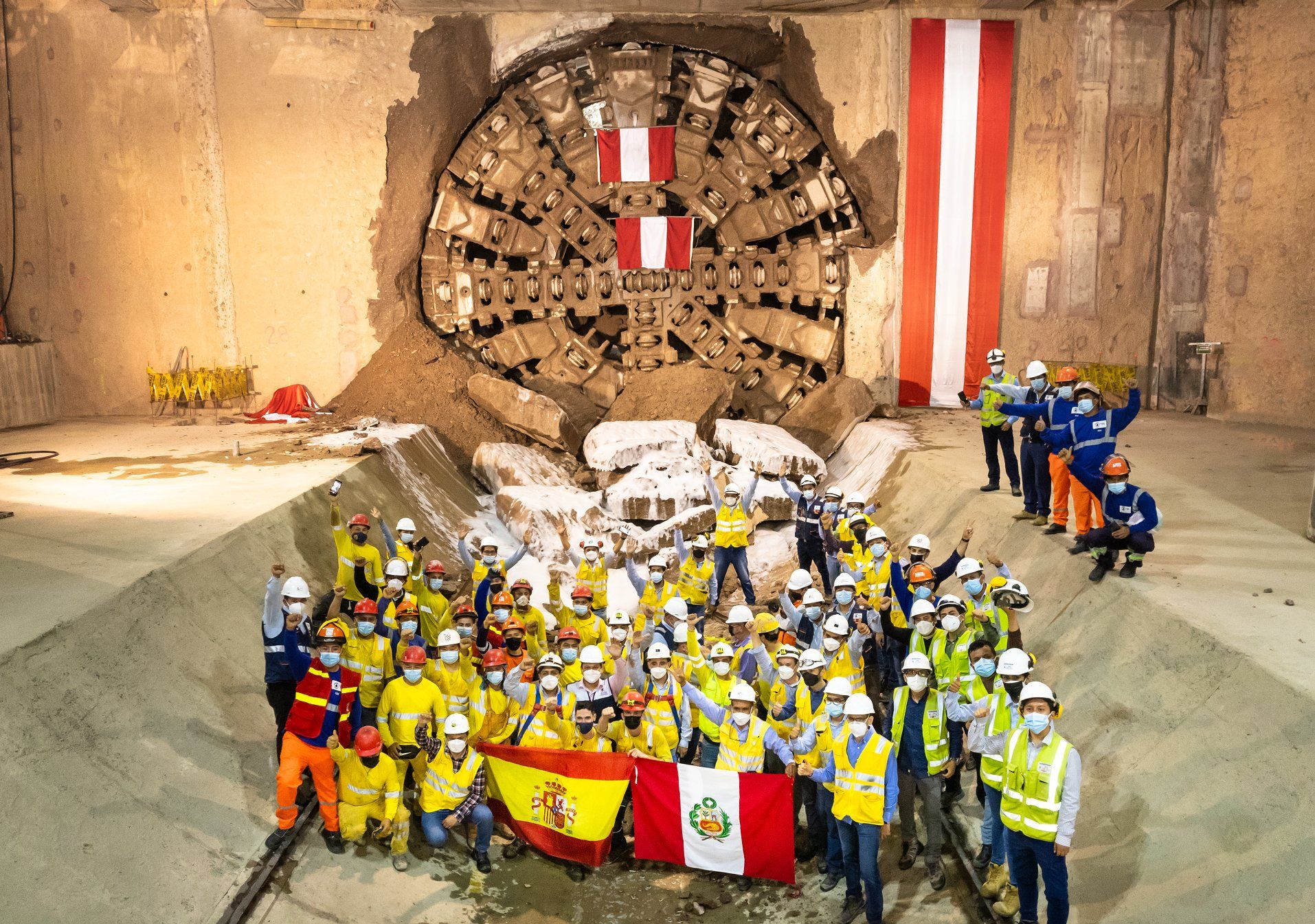
Line 2 is the most important infrastructure project currently under construction in Peru — full stop. Running 27 kilometres east–west under Lima from Ate to the port of Callao, with an 8-kilometre branch to the airport as the first section of future Line 4, it is Lima's first fully automated underground metro and is being built by some of the world's most experienced metro contractors.
The concession — won by the Nuevo Metro de Lima consortium in 2014 — comprises Dragados (ACS Group, 25%), Iridium/Vialia (FCC, 19%), Webuild (formerly Salini-Impregilo, 19%), Ansaldo STS/Hitachi Rail (15% signalling), AnsaldoBreda/Hitachi Rail (12% rolling stock), and COSAPI (10% local). The first 5 km and 5 stations opened in December 2023. Delays have been significant — the full line was originally due in 2020 — with complex urban tunnelling in Lima's gravelly soils, coordination with surface utilities, and multiple contractor challenges contributing to slippage. Full completion is now expected in the late 2020s.
Total- 35 km, 35 stations (all underground)
First Section- 5 km / 5 stations open Dec 2023
Automation- GoA4 — fully driverless
Sponsor(s)- Sociedad Concesionaria Metro de Lima Línea 2 S.A.
Location- Lima East (Ate) → Callao port (west) — 27 km + 8 km Gambetta branch
Key Contractors & Suppliers
Lead Civil / Concession (25%)- Dragados S.A. (ACS Group)- Spain -
Civil Works (19%)-Webuild S.p.A. (formerly Salini-Impregilo)- Italy
Rolling Stock (12%) — 42 trains- Hitachi Rail (AnsaldoBreda) — Driverless metro cars- Italy / Japan
Track Design (Line 2 final section)- TYPSA - Spain
Tunnelling Monitoring-Lombardi Engineering- Switzerland-Concession Partner (19%) - Vialia / Iridium (FCC Group)- Spain
Signalling / Systems (15%)- Hitachi Rail (Ansaldo STS) — CBTC ATO GoA4- Italy / Japan
Local Contractor (10%)- COSAPI S.A.- Peru
Electrification (Line 2 + Line 4 Phase 1)-Siemens (contracted by Ansaldo STS)- Germany- Financing- IDB ($750m) + World Bank ($300m) + China Co-financing Fund- Multilateral / China
Metro de Lima Línea 2 S.A. holds the 35-year concession (design, finance, build, operate, maintain). Ansaldo STS's $710m systems scope covers CBTC signalling, power supply, telecoms, platform screen doors, AFC and SCADA — plus 30 years of operation.
Development Progress- 62%
6. Chancay Megaport
China's Pacific Gateway — Already Open and Expanding
~US$3.5bn (Phase 1: ~US$1.3bn)
On 14 November 2024, China's President Xi Jinping and Peru's President Boluarte jointly inaugurated the Port of Chancay via video link — a moment that announced the arrival of South America's most strategically significant new piece of infrastructure. The first fully private port in Peru, Chancay is the centrepiece of China's Belt and Road investment in the continent.
COSCO acquired its 60% stake for $225 million in 2019, triggering a $3.5 billion total construction and fit-out programme. Phase 1 — representing $1.3 billion of investment — was completed on time despite Covid, making it a rare infrastructure delivery success story in Latin America. The port's construction contractor was Consorcio CHECSAC-CCCC4TH — a Chinese consortium of China Communications Construction Company (CCCC) and China Harbour Engineering Company. Phase 1 capacity stands at 1 million TEU annually; the full four-phase buildout targets over 4 million TEU plus bulk and RoRo. A $975m syndicated loan from Chinese banks (led by Bank of China) financed construction. The port has already reduced Lima–Asia transit times from 35 days to 23.
Phase 1 Capacity1 million TEU/year — operational Nov 2024
Full Capacity4+ million TEU + bulk + RoRo (4 phases)
Transit Time Saving 35 days → 23 days to Asia
Sponsor(s) COSCO SHIPPING Ports Ltd (60%) + Volcan Compañía Minera S.A.A. (40%)
Location Chancay, Huaral Province — 60 km north of Lima
Suppliers / Contractors
-
Port Developer / Operator (60%) — COSCO SHIPPING Ports Ltd (state-owned) (China)
-
Minority Shareholder (40%) — Volcan Compañía Minera S.A.A. (Peru)
-
Construction Contractor (EPC) — Consorcio CHECSAC-CCCC4TH: CCCC + CHEC (China)
-
Syndicated Loan lead — Bank of China (US$975m facility, March 2023) (China)
-
Crane & Port Equipment — ZPMC (Shanghai Zhenhua Heavy Industries) (China)
-
Smart Port Technology — COSCO proprietary systems + Huawei (IoT) (China)
7. Lima Metro — Line 4
Connecting the Airport to Lima's Metro Network
~US$3.739bn
Line 4 will give Lima a direct metro connection to Jorge Chávez International Airport — a gap that has long been glaring given the city's status as South America's key aviation hub. The 8-kilometre Faucett–Gambetta branch, currently being built under the Line 2 concession, is Line 4's first section.
The full Line 4 project involves extending and completing the remaining corridor beyond the airport branch, creating a dedicated cross-city route. Peru's Minister of Economy and Finance has set a 2026 award target for both Lines 3 and 4 under PPP structures, with pre-investment studies already approved. At $3.739 billion it is the smaller of the two new metro lines, but its airport link gives it outsized economic significance. The PPP model is preferred over G2G given the need to avoid compromising the fiscal position.
Faucett – Gambetta Branch8 km — under construction as Line 2 scope
Full Line 4PPP — 2026 award target
Key Feature- Airport connection
Sponsor(s) - Government of Peru / MTC — via ProInversión PPP
Location- Lima — airport link + east–west corridor
Suppliers/ Contractors
-
Airport Branch (under Line 2 scope) — Nuevo Metro de Lima consortium (same as Line 2) (Spain/Italy/Peru)
-
Full Line 4 EPC (TBD) — PPP tender to be launched; major metro contractors expected (International)
-
Likely Rolling Stock contenders — Hitachi Rail, Alstom, CAF, Siemens Mobility (Japan/France/Spain/Germany)
8. Anillo Vial Periférico
Lima's $3.4bn Peripheral Ring Road — Signed and Building
~US$3.4bn
Lima is one of Latin America's most congested megacities. Its road network, designed for a fraction of today's population, has reached saturation. The Anillo Vial Periférico — a 34.8-kilometre urban toll road ring linking 11 districts and Callao — is the single most important intervention in Lima's surface transport history.
In April 2024, ProInversión awarded the 30-year concession to a consortium of three Spanish giants: Ferrovial (through its Cintra toll road subsidiary, 35%), Sacyr (32.5%) and ACCIONA (32.5%). The contract was formally signed with Peru's Ministry of Transport in November 2024. Construction is expected to start in late 2025, with the consortium having been the sole bidder. The project will reduce average journey times by an estimated 50% across the corridors it serves, and is projected to generate over 70,000 direct and indirect jobs during construction.
Length- 34.8 km, 3 lanes per direction
Concession- 30 years — co-financed PPP
Journey Time Saving~50% reduction on key corridors
Sponsor(s)- Sociedad Concesionaria Anillo Vial (Ferrovial-Cintra 35% / Sacyr 32.5% / ACCIONA 32.5%)
Location- Metropolitan Lima — 11 districts + Callao, 34.8 km
Key Suppliers / Contractors
-
Lead Concessionaire (35%) — Cintra (Ferrovial S.A.) (Spain)
-
Concessionaire (32.5%) — Sacyr Concesiones S.L. (Spain)
-
Concessionaire (32.5%) — ACCIONA Concesiones (Spain)
-
Client / Grantor — ProInversión + Ministry of Transport (MTC) (Peru)
-
ITS / Digital Systems (expected) — Indra / Thales (Intelligent Transport Systems) (Spain/France)
-
BIM / Design Management — Internal consortium capability (all three have Lima precedent) (Spain)
Development Progress; 12%
9. Jorge Chávez International Airport Expansion
Lima's New Terminal — Now Open, Still Expanding
~US$2bn
Jorge Chávez International Airport — Lima's gateway to the world — was straining under the weight of 23 million annual passengers. The $2 billion expansion programme has now delivered its centrepiece: a brand-new terminal three times larger than its predecessor, which opened on 1 June 2025 after years of delays.
The EPC contractor for the terminal building was the Inti Punku consortium — Sacyr (Spain, 51%) and Cumbra (Peru, 49%) — who built the 270,000 m² terminal including seismic isolation (Lima's high earthquake risk demanded a specially engineered base isolator system). Also completed: a second 3,480m runway (built by Sacyr Ingeniería + GyM), a new 65m air traffic control tower (built by the Wayra consortium of Ferrovial, ACCIONA and JJC), and a fuel pipeline system. Financing came from seven international banks totalling $1.25bn. By end 2025 the terminal will expand further to reach full 40-million-passenger annual capacity.
Terminal Size- 270,000 m² — 5 levels, 60 boarding gates
Annual Capacity- 40 million passengers (full buildout)
Second Runway- 3,480 m — operational April 2023
Sponsor(s) - Lima Airport Partners S.R.L. (LAP) — Fraport 80.01% / IFC 19.99%
Location- Callao, 11 km northwest of Lima centre
Key Contractors & Suppliers
-
Terminal EPC (51%) — SACYR Ingeniería e Infraestructuras (Spain)
-
Terminal EPC (49%) — Cumbra Perú S.A.C. (Peru)
-
Second Runway — Sacyr Ingeniería + GyM S.A. (Spain/Peru)
-
ATC Tower + Airside Buildings — Wayra Consortium: Ferrovial + ACCIONA + JJC (Spain/Peru)
-
Terminal Design — Cemosa Ingeniería y Control (Lead design) (Spain)
-
Concession Operator — Lima Airport Partners (Fraport subsidiary) (Germany/Peru)
-
Debt Financing (US$1.25bn) — BBVA, IDB Invest, KfW IPEX, MUFG, Scotiabank, SocGen, SMBC (Spain/Multilateral/Germany/Japan/Canada)
Development Progress: 75%
10. Longitudinal de la Sierra Highway — Tramo 4
965 km of Highland Highway Connecting Five Regions
~US$1.582bn
Peru's highlands are spectacularly beautiful and spectacularly underconnected. The Longitudinal de la Sierra Highway has been incrementally built across multiple sections over decades; Tramo 4 — spanning 965 kilometres across five regions — is the final and most ambitious piece of this national puzzle.
ProInversión prequalified seven bidders from Latin America, Europe and Asia for the 25-year co-financed PPP concession. The shortlist includes Sacyr Concesiones (Spain), Concesionaria Vial del Centro (a Peru-Ecuador consortium), OHL (Spain), China Communications Construction Company (CCCC), Consorcio Carretera de los Andes, Operadora Surperú, and Consorcio R&R (Argentine-Peruvian). The award process, originally targeted for Q4 2024, was delayed into 2025. Once awarded, the concession covers rehabilitation, construction, improvement and maintenance of the entire 965-kilometre route for a quarter century — improving access for 1.6 million people in historically underserved regions.
Length-965 km across 5 regions
Concession- 25 years — co-financed PPP
Beneficiaries1.6 million in Junín, Huancavelica, Ica, Ayacucho, Apurímac
Sponsor(s)- ProInversión / Ministry of Transport (MTC) — 25-year co-financed PPP
Location -Junín → Huancavelica → Ica → Ayacucho → Apurímac — 965 km
Key Contractors & Suppliers
Prequalified Bidder-mSacyr Concesiones S.L.- Spain
Prequalified Bidder -OHL (Obrascon Huarte Lain)- Spain
Prequalified Bidder- Concesionaria Vial del Centro (Construcción y Administración S.A. + Hidalgo e Hidalgo) - Peru / Ecuador
Prequalified Bidder-China Communications Construction Company (CCCC) — Peru Branch- China
Prequalified Bidder-Consorcio R&R (Benito Roggio + Rovella Carranza)-Argentina
Client / Grantor-ProInversión + MTC-Peru
The final award — expected Q2 2025 per latest ProInversión guidance — will pit Spanish, Chinese, Peruvian and Argentine operators against each other in one of Peru's most competitive concession tenders. CCCC's presence signals China's continued appetite for Andean highway concessions.
Development Progress-20%
Frequently Asked Questions: Peru’s infrastructure boom (2025–2026)
What is the total value of Peru’s top 10 infrastructure projects in 2025–2026?
Public estimates put the top 10 projects at ~US$54.5bn in combined capex. That pipeline spans rail, metro, port, highways and aviation—from large rail concepts (e.g., Chancay–Pucallpa) to PPP road programmes such as Longitudinal de la Sierra Tramo 4.
Who built the Chancay megaport — and who operates it?
Construction (EPC): Consorcio CHECSAC-CCCC4TH (CCCC + CHEC).
Developer/operator: COSCO SHIPPING Ports (60%), with Volcan (40%) as minority shareholder. Phase 1 began operations in 2024 (as reported), with transit-time improvements to Asia commonly cited in project communications.
Who won the Anillo Vial Periférico concession in Lima?
A 30-year, ~US$3.4bn concession awarded to a Spanish consortium: Cintra/Ferrovial (35%), Sacyr (32.5%), and ACCIONA (32.5%). The agreement was signed with Peru’s transport authorities in late 2024, with construction widely expected to start from late 2025 (subject to final approvals and close).
Which companies are building Lima Metro Line 2?
The concession is held by Sociedad Concesionaria Metro de Lima Línea 2, with a delivery team that includes Dragados (ACS), Iridium/Vialia (FCC), Webuild, and COSAPI, plus Hitachi Rail for major systems/rolling stock packages (as structured in the concession). Initial passenger service has already started on a first section, with full completion targeted for the late 2020s (reported timelines).
Who built the new Jorge Chávez airport terminal in Lima?
Main terminal EPC: Inti Punku — Sacyr (51%) + Cumbra Perú (49%).
Lead design: Cemosa Ingeniería y Control.
Second runway: Sacyr + GyM.
ATC tower & airside buildings: Wayra Consortium (Ferrovial + ACCIONA + JJC).
Operator: Lima Airport Partners (LAP), a Fraport subsidiary, delivering a ~US$2bn modernisation programme.
What delivery models is Peru using for mega-infrastructure?
Peru is running three models in parallel:
-
PPP concessions (e.g., major roads, metro lines) to bring in private capital and allocate risk contractually.
-
Government-to-Government (G2G) procurement to accelerate delivery (used since 2019; also discussed for future metro packages).
-
China-linked financing/BRI structures for strategic port/rail-linked developments (e.g., Chancay and related corridor concepts).